Confined Space Entry Program Requirements in Canada: 7 Elements You Must Have
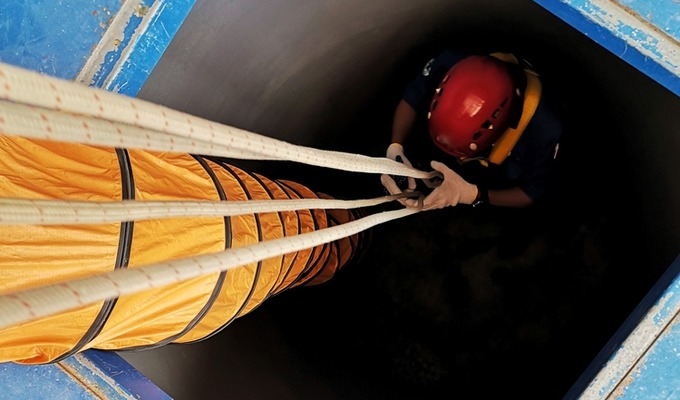
By the Système Préventis OHS Team | Confined Spaces | OHS Programs
Confined space accidents are among the most lethal events in Canadian workplaces. A single atmospheric hazard — oxygen deficiency, toxic gas accumulation, or a flammable atmosphere — can incapacitate an entrant in seconds. When an untrained bystander attempts a rescue without proper equipment, a single fatality frequently becomes two or three. Most confined space deaths in Canada are preventable, and the evidence consistently points to the same root causes: no written programme, no entry permit, no atmospheric testing, and no rescue plan. The workers who die in confined spaces are not unlucky — their employers failed to build and maintain the programme that would have protected them.
This article explains what a confined space entry programme must contain under Canada's national standard CSA Z1006:16, Management of Work in Confined Spaces, and under Quebec's Regulation respecting occupational health and safety (RROHS), sections 296.1 to 312 — updated in July 2023 and further amended in June 2025. Whether you are building a programme from scratch or auditing one that already exists, these seven required elements are your compliance baseline.
What Is a Confined Space Under Canadian Law?
Getting the definition right is the first and most critical step. In Quebec, the RROHS section 1 defines a confined space (espace clos) as any space that is totally or partially enclosed — such as a reservoir, silo, vat, hopper, chamber, vault, pit, manure pit, sewer, pipe, chimney, access shaft, or tank — and that presents one or more of the following hazards due to its confinement:
- A risk of asphyxiation, intoxication, loss of consciousness or judgment, fire, or explosion associated with the atmosphere or internal temperature
- A risk of engulfment by free-flowing materials (solids or liquids)
- Any other risk likely to compromise the health or safety of a person who enters it
The 2023 RROHS update tightened this definition to focus on two criteria: design and risk. The space does not need to have restricted access to qualify as a confined space in Quebec — any enclosed or partially enclosed space presenting one of the above hazards must be treated as such. When in doubt, treat the intervention as a confined space entry.
Under CSA Z1006, a confined space is similarly defined as an enclosed or partially enclosed space not designed or intended for continuous human occupancy, with restricted means of entry or exit, which may become hazardous to a person entering it. Both frameworks require employers to inventory and designate all confined spaces on their premises before any work programme is built.
ℹ Confined Space: Common Examples by Sector
- Manufacturing: storage tanks, mixing vessels, vats, hoppers, ductwork
- Municipalities: sewers, manholes, water towers, pump stations, valve chambers
- Construction: excavations, tunnels, caissons, piers
- Agriculture: grain bins, silos, manure storage pits, fermentation tanks
- Healthcare / Utilities: boilers, pressure vessels, HVAC plenums, underground vaults
- Oil & Gas: pipelines, process vessels, separators, wellheads
If workers enter it and it presents an atmospheric, engulfment, or other serious hazard, it is a confined space — regardless of whether it has historically been treated as one.
The 7 Required Elements of a Confined Space Entry Programme
A compliant confined space entry programme in Canada is not a single document — it is a management system. Both CSA Z1006 and the Quebec RROHS require that the programme be written, implemented, maintained, and regularly reviewed. The following seven elements are required under both frameworks and represent the minimum that any Canadian employer must have in place.
Element 1 — Confined Space Inventory and Hazard Designation
Before any entry can be managed safely, every confined space on a worksite must be identified, inventoried, and assessed. Under RROHS section 300, the employer must gather information on every confined space, including its design and purpose, the work to be carried out inside, the atmospheric risks (oxygen level, toxic or flammable gas concentration), risks related to free-flowing materials, and any other factors that could compromise evacuation or worker safety.
CSA Z1006 Clause 6 requires employers to assess each space and determine which spaces require an entry permit based on the hazards present. Not all confined spaces are equal: some can be managed with atmospheric monitoring and ventilation alone, while others require the full permit system, continuous atmospheric testing, attendants, and a standby rescue team. The hazard designation drives every other element of the programme.
Element 2 — Written Entry Procedures and the Permit System
The entry permit is the operational core of a confined space programme. Under RROHS section 304, before any worker enters a confined space, a responsible person must issue a written permit that authorizes the entry and documents the hazard controls in place. The permit must be specific to the space, the work, and the day of entry — it is not a standing authorization.
Under CSA Z1006 Clause 8, the entry permit must document: the identity of the space, the purpose of the entry, the authorized duration, the atmospheric test results before entry, the ventilation measures in place, the PPE required, the names of authorized entrants, the name and station of the attendant, the rescue plan reference, and the authorizing signature of the entry supervisor. The permit must be posted at the entry point and retained as a record after the work is complete.
⚠ What a Permit-Required Confined Space Entry Looks Like in Practice
- Step 1: Qualified person reviews the space inventory and identifies all hazards for this specific entry.
- Step 2: Atmospheric testing performed before entry by a qualified person using calibrated equipment.
- Step 3: Ventilation established and confirmed effective before the permit is issued.
- Step 4: Entry permit completed, signed, and posted at the entry point.
- Step 5: Attendant stationed outside the space for the full duration of entry.
- Step 6: Entrant(s) enter with required PPE; continuous atmospheric monitoring maintained.
- Step 7: Entry terminated immediately if conditions change; permit cancelled.
- Step 8: Permit retained as a record after work completion.
Element 3 — Atmospheric Testing and Monitoring
Atmospheric hazards kill faster than any other confined space risk. Under RROHS sections 301 and 306, atmospheric conditions must be verified by a qualified person (personne qualifiée) using calibrated detection equipment before any worker enters, and monitoring must continue throughout the work. As of June 5, 2025, CNESST updated the minimum oxygen concentration for work in a confined space in Quebec to 19.5% by volume (revised from the 20.5% threshold introduced in the July 2023 amendments). The maximum concentration of flammable gases or vapours remains at or below 5% of the lower explosive limit (LEL).
CSA Z1006 Annex C provides detailed guidance on atmospheric monitoring instruments, calibration requirements, and testing protocols. The standard emphasizes that atmospheric conditions in confined spaces can change rapidly due to work activities, purging, or ingress of hazardous substances — which is why continuous monitoring is required throughout entry, not just an initial pre-entry test.
Element 4 — Designated Roles: Qualified Person, Entry Supervisor, Attendant, and Entrant
A safe confined space entry requires four clearly defined roles, each with specific responsibilities. Both CSA Z1006 Clause 5 and RROHS section 297 establish these roles explicitly.
- Qualified person (personne qualifiée): A person who, by reason of knowledge, training, or experience, is able to identify, evaluate, and control the hazards of the confined space. Under RROHS section 297, at least one qualified person must be assigned to every confined space entry. Typically, an organization will have more than one.
- Entry supervisor: Responsible for verifying that all hazard controls are in place before authorizing entry, monitoring the permit conditions throughout the work, and terminating the entry if conditions change. The entry supervisor signs the permit.
- Attendant (surveillant): Stationed outside the confined space at all times during entry. The attendant monitors the entrant, maintains communication, tracks time in the space, monitors atmospheric conditions where continuous external monitoring is used, and initiates the rescue plan immediately if conditions deteriorate or the entrant becomes incapacitated. The attendant does not enter the space.
- Entrant (travailleur habilité): Under RROHS section 298 (updated July 2023), entrants must be 18 years of age or older. Entrants must be trained on the hazards specific to the space, the controls in place, and the procedures for emergency evacuation.
Element 5 — Rescue Plan and Emergency Response
The rescue plan is the element most often missing or inadequate in confined space programmes. The 2023 RROHS amendments significantly strengthened rescue planning requirements. Under RROHS section 308, a written rescue plan must be prepared before any worker enters a confined space. The plan must specify the rescue equipment selected to suit the specific hazards and configuration of the space, the roles of each member of the rescue team, communication procedures, and the conditions under which external emergency services must be contacted.
CSA Z1006 Clause 6.4 and Annex B require employers to assess whether non-entry rescue (retrieving the entrant from outside the space using mechanical means such as a retrieval system and lifeline) is feasible before any entry-based rescue is planned. Non-entry rescue is the preferred method wherever technically possible. If entry-based rescue is required, rescue team members must be specifically trained and equipped, and the rescue plan must be drilled at regular intervals. A standby rescue arrangement must be confirmed before the entry permit is issued.
Element 6 — Training for All Roles
Under RROHS section 303, the employer must ensure that any person performing work in or around a confined space has received training appropriate to their role. CSA Z1006 Clause 7 specifies that training must be role-specific: the qualified person, entry supervisor, attendant, and entrant each require different training content. Generic "confined space awareness" training does not satisfy this requirement.
Training must cover: the definition and types of confined spaces present in the workplace, the specific hazards associated with each designated space, the use and calibration of atmospheric monitoring equipment, the PPE required for each space and each hazard type, entry permit procedures, emergency communication, and the rescue plan. Training records must be retained and must demonstrate that each worker was trained on the specific spaces and conditions they will encounter.
Element 7 — Documentation, Review, and Programme Audit
A confined space programme is not a one-time exercise. Both CSA Z1006 Clauses 9 and 10 and RROHS section 300 require employers to maintain programme documentation, review the programme after any incident or near-miss, and conduct periodic audits to verify that procedures remain accurate and effective. Documentation requirements include:
- The confined space inventory with hazard designations for each space
- Entry permit records for every entry completed (retained for a minimum period required by applicable OHS legislation)
- Atmospheric test records, including instrument calibration logs
- Training records for every qualified person, supervisor, attendant, and entrant
- Rescue plan documents, including drill records
- Incident investigation reports for any confined space event
- Programme review records showing annual or post-incident updates
Quebec-Specific Confined Space Requirements Under the RROHS
Quebec's RROHS Section XXVI (articles 296.1 to 312), updated substantially in July 2023 and further amended in June 2025, includes several requirements that differ from or go beyond the national CSA Z1006 standard. Employers with operations in Quebec must comply with both frameworks, applying the more stringent requirement where they diverge.
The Qualified Person Requirement
Quebec's RROHS places particular emphasis on the role of the qualified person (personne qualifiée). The qualified person must identify and evaluate all hazards before entry, determine the appropriate prevention measures, authorize the work, and verify that conditions remain safe throughout. Unlike some other provinces, Quebec does not use the term "entry supervisor" — the qualified person holds the combined authority of hazard assessment and work authorization.
Design Obligations for New and Renovated Confined Spaces
A significant addition from the 2023 amendments is RROHS section 297.1, which imposes design obligations on new confined spaces and major renovations. When purchasing or constructing a new confined space, employers must now prioritize methods and equipment that allow work to be performed from outside the space wherever possible. Where interior access is necessary, the design must incorporate permanent features to control atmospheric hazards, facilitate safe movement and evacuation, and support rescue operations. This applies to construction projects, equipment upgrades, and facility renovations.
Updated Atmospheric Thresholds
📊 Current Atmospheric Limits for Confined Space Entry in Quebec (as of June 5, 2025)
- Oxygen: minimum 19.5% by volume (updated June 5, 2025 — the 20.5% threshold introduced in July 2023 has been revised back to 19.5%)
- Note: Even when oxygen is above 19.5%, if it falls below its normal concentration in air, the situation must still be analyzed before entry.
- Flammable gases or vapours: maximum 5% of the lower explosive limit (LEL)
- Toxic contaminants: concentrations must not exceed applicable occupational exposure limits (OELs)
Continuous atmospheric monitoring is required throughout entry, not only pre-entry testing.
Free-Flowing Material Hazards
The 2023 RROHS amendments expanded the provisions for confined spaces used to store free-flowing solids or liquids. Under RROHS section 311, entry into a confined space used to store free-flowing materials is prohibited unless it is absolutely necessary. When entry is indispensable, specific precautionary measures must be in place before access is authorized — including isolation of all feed and discharge systems, lockout of all energy sources, atmospheric testing, and specific fall and engulfment prevention controls. Liquid-material spaces are governed by section 312, which requires area isolation and flow control procedures to prevent drowning.
Auditing Your Existing Confined Space Entry Programme
For EHS managers and safety coordinators who already have a programme in place, the following questions help identify whether it reflects current requirements under CSA Z1006 and the updated Quebec RROHS.
- Inventory current: Does your confined space inventory reflect all spaces currently on your premises, including spaces added, modified, or reclassified since the last review? The 2023 RROHS definition changes may have brought spaces into scope that were previously not classified as confined spaces.
- Atmospheric thresholds correct: Do your procedures and monitoring protocols reflect the current Quebec threshold of 19.5% minimum oxygen and 5% LEL maximum for flammable gases (as of June 2025)? Instruments programmed to the 20.5% threshold from the 2023 amendments need recalibration or reprogramming.
- Rescue plan specific and tested: Does each confined space have its own rescue plan, not a generic procedure? Has the plan been rehearsed in the last 12 months? Is the rescue equipment staged and confirmed serviceable?
- Roles assigned and trained: Can you identify a named qualified person for each confined space in your inventory? Are training records current for all supervisors, attendants, and entrants for the specific spaces and hazard types they work with?
- Permit records retained: Are completed entry permits being retained as records? Do they contain all required elements including atmospheric test results, attendant name, and rescue plan reference?
- Design requirements addressed: For any confined spaces constructed, purchased, or renovated since July 2023, has RROHS section 297.1 been applied to the design and fit-out?
How Système Préventis Supports Your Confined Space Entry Programme
Managing a confined space programme across a facility with dozens of designated spaces — or across multiple sites — requires a system, not a spreadsheet. Système Préventis delivers a dedicated confined space module within its integrated OHS platform, built to operationalize all seven required programme elements under both CSA Z1006 and the Quebec RROHS.
Confined Space Inventory and Hazard Classification
The Système Préventis confined space module maintains a centralized, site-linked inventory of every designated confined space. Each space record stores its hazard classification, access restrictions, atmospheric profile, required PPE, designated qualified persons, and the current version of its entry procedure. When a space is modified or a new space is identified, the record can be updated and the change logged for audit purposes.
Entry Permit Management
The platform's digital permit workflow guides the entry supervisor through every required permit field under RROHS section 304 and CSA Z1006 Clause 8. Permits are linked to the specific space record, time-stamped, and automatically retained as permanent records. Supervisors and safety managers can review active and historical permits from any device, and the system flags permits that are approaching their authorized duration.
Atmospheric Testing and Monitoring Logs
Atmospheric test results are recorded directly in the platform, linked to the entry permit and the space record. Instrument calibration records are stored alongside test data, supporting the documentation requirements under CSA Z1006 Annex C. When results fall outside acceptable thresholds, the permit workflow prevents authorization until the conditions are corrected and re-tested.
Rescue Plan Documentation
Each confined space record in the platform includes a linked rescue plan document, with fields for rescue method (non-entry preferred), equipment specifications, rescue team assignments, and drill records. The system tracks drill completion dates and generates alerts when rehearsals are overdue, ensuring that rescue readiness is maintained continuously rather than checked only at incident time.
Training Management and Role Records
The Système Préventis training module manages confined space training for all four roles — qualified person, entry supervisor, attendant, and entrant — with training linked to specific spaces and hazard categories. Expiry tracking and automated re-training alerts prevent the silent compliance gaps that arise when workers rotate roles or when spaces are reclassified. All training completions are stored as records available for CNESST inspection. This documentation directly supports the employer's due diligence position under the Loi sur la santé et la sécurité du travail (LSST) in any enforcement proceeding.
Confined space accidents remain among the most preventable — and most tragic — events in Canadian workplaces. Under CSA Z1006:16 and Quebec's RROHS sections 296.1 to 312, every employer whose workers enter confined spaces must maintain a written programme with seven core elements: a current space inventory and hazard designation, a permit system with written entry procedures, atmospheric testing by a qualified person before and during entry, clearly defined roles for qualified persons, entry supervisors, attendants, and entrants, a specific and rehearsed rescue plan for each space, role-specific training with current records, and documented programme reviews. Système Préventis's confined space module brings all seven elements into one integrated platform, so your programme is audit-ready every day — not only when an inspector arrives.
Frequently Asked Questions
What are the confined space entry requirements in Quebec?
Quebec's RROHS sections 296.1 to 312 require employers to identify all confined spaces, gather hazard information before entry, perform atmospheric testing by a qualified person, ensure adequate ventilation, issue a written entry permit, station an attendant outside the space at all times, prepare a written rescue plan for each space, and ensure all workers are trained for their specific role. The minimum oxygen concentration for entry is 19.5% by volume (as of June 2025), and flammable gas concentrations must be at or below 5% of the lower explosive limit.
What must a confined space entry permit include in Canada?
Under CSA Z1006 and Quebec's RROHS, an entry permit must document: the identity and location of the space, the purpose and authorized duration of the entry, the atmospheric test results before entry, the ventilation measures in place, all PPE required, the names of authorized entrants, the name and location of the attendant, the rescue plan reference, and the authorizing signature of the entry supervisor. The permit must be posted at the entry point and retained as a record after entry is complete.
Does every confined space require a rescue plan in Canada?
Yes. Both CSA Z1006 and Quebec's RROHS require a written rescue plan for every confined space where entry is authorized. The plan must be specific to the configuration and hazards of the space. It must identify the preferred rescue method (non-entry retrieval wherever feasible), the rescue equipment, the roles of each rescue team member, communication procedures, and conditions triggering contact with external emergency services. The rescue plan must be prepared and confirmed before the entry permit is issued — not after an emergency occurs.
What is a qualified person for confined space entry under Quebec's RROHS?
Under RROHS section 297, a qualified person (personne qualifiée) is someone who, by reason of their knowledge, training, or experience, is able to identify, evaluate, and control the hazards associated with a confined space. At least one qualified person must be assigned to each confined space entry. The qualified person is responsible for gathering pre-entry hazard information, authorizing the work, and verifying that safety conditions are maintained throughout the entry.
How often must confined space training be renewed in Canada?
Neither CSA Z1006 nor most provincial regulations specify a fixed renewal interval for confined space training. However, CSA Z1006 Clause 7 requires that training be reviewed and repeated whenever workers change roles, when new confined spaces are identified or reclassified, after any incident or near-miss, and when procedures or equipment change. Best practice and CNESST guidance recommend annual training review, with training records maintained and available for inspection at all times.
Sources
- CNESST — Espaces clos (Confined Spaces)
- Règlement sur la santé et la sécurité du travail (RROHS), Section XXVI, articles 296.1–312 — Publications du Québec
- CSA Z1006:16 (R2020), Management of Work in Confined Spaces — CSA Group
- CNESST — Modifications réglementaires espaces clos (July 2023 amendments), Document de présentation
- CNESST — Décret modifiant le RSST (June 5, 2025 oxygen threshold amendment)
- IRSST — ECLOS : Outil de gestion des risques en espace clos
- CCOHS — Confined Space: Programme Requirements
- Loi sur la santé et la sécurité du travail (LSST) — Publications du Québec
Système Préventis | A QuadShift Company | May 2026

Heading
Lorem ipsum dolor sit amet, consectetur adipiscing elit. Suspendisse varius enim in eros elementum tristique.