WHMIS GHS 7 & 8 Updates: What Canadian Employers Must Know Before December 2025
Préventis OHS Team | WHMIS | SDS Management
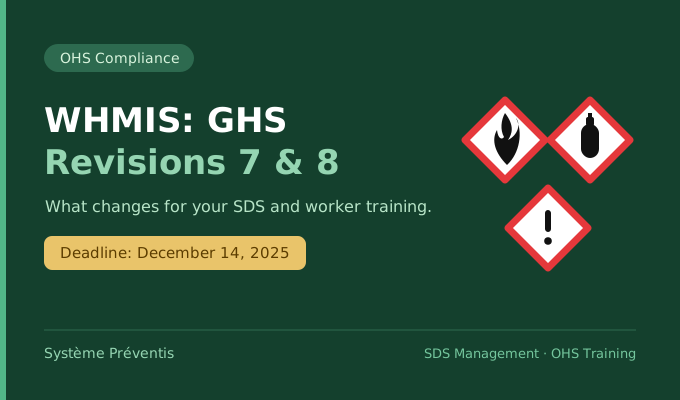
Canadian workplaces rely on the Workplace Hazardous Materials Information System (WHMIS) to communicate chemical hazards to workers. In December 2022, Health Canada amended WHMIS to align with the 7th edition — and selected provisions of the 8th edition — of the Globally Harmonized System of Classification and Labelling of Chemicals (GHS). The compliance deadline for these changes is December 14, 2025. Organizations that have not updated their Safety Data Sheets (SDS) and training programs face serious regulatory exposure.
This article explains what changed, what it means for employers and suppliers, and how your organization can achieve compliance before the deadline. Whether you manage a single facility or a multi-site operation, understanding these updates is a core due diligence obligation under Canada's Hazardous Products Act (HPA) and Hazardous Products Regulations (HPR).
What Are the WHMIS GHS 7 & 8 Updates?
When Canada first adopted GHS in 2015 — creating what was then called WHMIS 2015 — it aligned with the 5th revision of GHS. The December 2022 amendments brought Canada's framework in line with GHS Revision 7 in full, and incorporated targeted elements of GHS Revision 8. Going forward, WHMIS will not carry a year designation; it will simply be called WHMIS.
These amendments affect three pieces of legislation that every employer working with hazardous products must understand: the Workplace Hazardous Materials Information System regulations, the Hazardous Products Act, and the Hazardous Products Regulations.
Why GHS Revisions Matter
The GHS is a United Nations framework designed to standardize how chemical hazards are communicated globally. Each revision refines hazard classification criteria, improves SDS formatting requirements, and introduces new hazard categories based on evolving science. Aligning WHMIS with GHS 7 and 8 ensures that Canadian workers and suppliers use the same hazard communication language as their international counterparts.
What Changed: Key WHMIS GHS 7 & 8 Updates by Category
1. Physical Hazard Classifications
The most significant structural change involves flammable gases, aerosols, and a brand-new hazard class for chemicals under pressure.
⚠ Key Physical Hazard Changes
- Flammable Gases — Category 1 is now split into two subcategories:
- Subcategory 1A: Pyrophoric gases and chemically unstable gases (higher hazard)
- Subcategory 1B: Non-pyrophoric, chemically stable flammable gases (lower hazard)
- Aerosols — Renamed from 'Flammable Aerosols.' A new Category 3 now covers non-flammable aerosols. Products classified as aerosols no longer need classification under Gases Under Pressure.
- Chemicals Under Pressure — A new hazard class, introduced from GHS Revision 8, with new pictograms and required hazard statements.
- Other updated classes include: Oxidizing Solids, Combustible Dust, Acute Toxicity, Carcinogenicity, Mutagenicity, and Respiratory Sensitization.
2. SDS Formatting Changes — Section 9 (Physical & Chemical Properties)
Section 9 of the SDS has been significantly revised. Several new fields are now mandatory, while others have been removed or renamed.
- Now required: Physical state, colour, particle characteristics, kinematic viscosity, and relative vapour density
- Removed: Odour threshold and evaporation rate (these may still be included as supplemental information, but must not be misleading)
- Renamed fields: 'Appearance' is now split into 'Physical State' and 'Colour'; 'Vapour Density' becomes 'Relative Vapour Density'; 'Viscosity' becomes 'Kinematic Viscosity'
3. SDS Section 3 — Ingredient Disclosure
Under the updated HPR, all hazardous ingredients present in a mixture above the relevant cut-off concentration must be disclosed in Section 3 — even if that ingredient does not contribute to the overall classification of the product as a hazardous product. This is a meaningful expansion of transparency requirements for both suppliers and downstream employers.
4. Water-Activated Toxicants
The amendments introduce a new disclosure requirement for substances that become toxic when they contact water. Relevant SDSs must include specific hazard statements addressing this mechanism of harm. This change has particular relevance for sectors handling reactive chemicals in wet or high-humidity environments.
Employer Obligations Under the Updated WHMIS GHS 7 & 8 Requirements
Employers' WHMIS obligations do not change fundamentally — but their content must be updated. Under the HPA and applicable provincial OHS legislation (including Quebec's Act respecting occupational health and safety and CNESST enforcement), employers must:
- Ensure all SDS in the workplace reflect the updated hazard classifications and Section 9 format
- Update worker education and training to cover the revised hazard classes, especially Flammable Gas subcategories 1A and 1B, the new Aerosols category, and Chemicals Under Pressure
- Verify that supplier-provided SDS are GHS 7 & 8 compliant and flag those that are not
- Update workplace labels that reference the affected hazard classes
- Document training updates as evidence of due diligence — CNESST and federal OHS inspectors may request records
Who Is Most Affected?
Any organization that uses, stores, or handles products classified under Flammable Gases, Aerosols, or Gases Under Pressure should prioritize its SDS review. This includes manufacturing, construction, oil and gas, municipal utilities, healthcare, and laboratory environments. Suppliers and manufacturers who produce hazardous products must update their SDS and ensure new classification logic is applied across their product lines.
The December 2025 Compliance Deadline: What It Means in Practice
The three-year transition period established with the December 2022 amendments ends on December 14, 2025. After this date, all SDS for products sold or used in Canadian workplaces must comply with the updated WHMIS requirements aligned with GHS 7 and 8. Non-compliant SDS will no longer satisfy the legal requirements under the HPR.
For employers, this means acting now — not in Q4 2025. SDS reviews, supplier follow-ups, training updates, and documentation all take time. Organizations with large chemical inventories or complex supply chains should begin their gap assessments immediately.
📋 Compliance Readiness Checklist
- Audit your SDS inventory: identify all products with Flammable Gas, Aerosol, or Gases Under Pressure classifications
- Contact your suppliers to request updated, GHS 7 & 8-compliant SDS
- Review all SDS Section 9 entries against the new mandatory field requirements
- Update workplace training programs to cover revised hazard classes and new subcategories
- Revise any workplace labels that reference affected classifications
- Document all updates and retain training records for due diligence purposes
How Système Préventis Supports WHMIS GHS 7 & 8 Compliance
Managing WHMIS compliance across a facility — let alone multiple sites — requires more than a filing cabinet of SDS. Système Préventis provides a fully integrated occupational health and safety platform designed to bring prevention, training, and occupational health management into a single, compliance-focused solution.
SDS and Chemical Risk Management
The Système Préventis SDS management module goes beyond simple document storage. The platform supports true chemical risk management: tracking which SDS in your inventory are due for review, flagging supplier documents that may not reflect the updated GHS 7 & 8 classifications, and maintaining a complete, accessible library that workers can consult in the field. This is critical as you transition your SDS inventory to meet the December 2025 deadline.
Training Management
WHMIS GHS 7 & 8 compliance requires updated worker training. The Système Préventis training management module enables organizations to schedule, deliver, and track WHMIS training completions across the workforce. When training content changes — as it must to reflect the new hazard subcategories — the platform helps ensure every worker's records reflect the most current program. Training completion records serve as direct evidence of employer due diligence in any CNESST inspection or incident investigation.
Systematic, Due-Diligence-First Approach
Système Préventis is built on the principle that due diligence is measured by results, not effort. All programs within the platform are designed in alignment with current laws, regulations, and standards — including the updated WHMIS requirements — so that your compliance posture is built into daily operations, not bolted on at audit time.
The WHMIS GHS 7 & 8 amendments represent the most significant update to Canada's hazardous materials communication framework since 2015. With a December 2025 compliance deadline, Canadian employers must act now to audit their SDS inventories, update worker training, and verify that supplier documents reflect the revised hazard classification requirements. Organizations that integrate their SDS management and training into a platform like Système Préventis are best positioned to meet the deadline — and to sustain compliance long after it passes.
Frequently Asked Questions
What is the deadline for WHMIS GHS 7 and 8 compliance in Canada?
The compliance deadline is December 14, 2025. This marks the end of the three-year transition period that began when Health Canada registered the amendments in December 2022. After this date, all Safety Data Sheets for hazardous products in Canadian workplaces must meet the updated Hazardous Products Regulations aligned with GHS Revision 7 and selected elements of Revision 8.
What hazard classes changed under WHMIS GHS 7 & 8?
The most significant changes involve Flammable Gases (now split into subcategories 1A and 1B), Aerosols (renamed, with a new non-flammable Category 3), and a new Chemicals Under Pressure hazard class from GHS Revision 8. Updates also affect Oxidizing Solids, Combustible Dust, Acute Toxicity, Carcinogenicity, Mutagenicity, and Respiratory Sensitization.
What changes are required on Safety Data Sheets for GHS 7 & 8?
Section 9 (Physical and Chemical Properties) must include new mandatory fields: physical state, colour, particle characteristics, kinematic viscosity, and relative vapour density. Odour threshold and evaporation rate are removed as required fields. Section 3 (Composition) must now disclose all hazardous ingredients above relevant cut-off concentrations, even if they do not contribute to the product's overall hazard classification.
What are the employer obligations for WHMIS training under GHS 7 & 8?
Employers must update their WHMIS education and training programs to ensure workers understand the revised hazard classes and subcategories — particularly the Flammable Gas subcategories 1A and 1B, the expanded Aerosols class, and the new Chemicals Under Pressure hazard class. Updated training records must be maintained as evidence of employer due diligence under the applicable provincial OHS Act and federal OHS Regulations.
Is WHMIS 2015 still valid after December 2025?
After December 14, 2025, SDS that comply only with the original WHMIS 2015 (GHS Revision 5) requirements will no longer meet Canada's Hazardous Products Regulations. The updated standard — aligned with GHS Revision 7 and 8 — will be the only compliant format. Employers should begin requesting updated SDS from their suppliers immediately and should not wait until the deadline to begin the transition.
Sources
- Health Canada — WHMIS Amendments to Align with GHS Revisions 7 & 8 (2022)
- Hazardous Products Act (R.S.C., 1985, c. H-3) — Justice Canada
- Hazardous Products Regulations — Justice Canada
- CNESST — Workplace Hazardous Materials Information System (WHMIS)
- United Nations — Globally Harmonized System of Classification and Labelling of Chemicals (GHS), 7th Revised Edition
- Act Respecting Occupational Health and Safety (LSST) — Québec
Système Préventis | A QuadShift Company

Heading
Lorem ipsum dolor sit amet, consectetur adipiscing elit. Suspendisse varius enim in eros elementum tristique.